
Some people call it AV- Audio Visual ,others slide -tape which is probably
more accurate as AV also covers film TV etc. This type of communication was originally
conceived during the Victorian era and I have an old projector which takes old
glass slides - see separate page. It was revived by the French in the fifties
and appeared in the UK in the mid sixties. I remember being hooked after seeing
a show in Manchester the mid sixties which showed two and a quarter slides with
music.
My first method of syncing slides with a sound track way back in the
sixties was to use a device that put a 1000 cycle pulse on one track of the tape.
On playback one could either set the projector to change on reaching the pulse
or one could listen for the pulse and do the change manually.
I later made
a home made 'dissolve device made out of cardboard and bits of elastic band !
It didn't last for too many performances. The first show I did was in March 1969
at my camera club in Chorlton, Manchester .It was a combined effort with Eddie
Roper. We only had one Letiz projector each !
At an Audio Visual convention
at Avon Tyrell in 1972 John Dawkins showed an unusual method of dissolving using
crossed polarisers but one of the best devices pioneered by Sir George Pollock
was the Duofade (more below)
There will be many people who have never had the pleasure of viewing a slide
tape show and when viewed on a ten foot screen with Hi Fi sound in a darkened
room or hall it can have a tremendous impact.
In this age of DVD, Digital
TV and Computer Technology slide tape may seem to be old fashioned but it has
certain qualities of communication that are very rewarding.
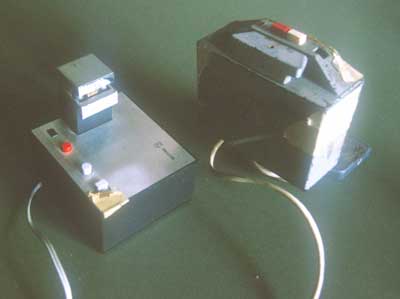
Over on the
right are two versions of the Phillips synchronizer for use with reel-to reel
tape decks to put a pulse on the spare track.
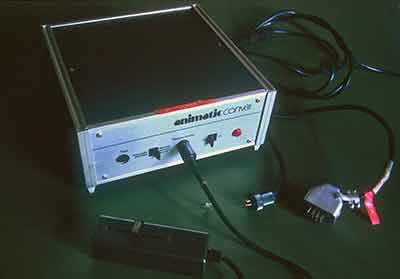
One
of the first amateur automatic dissolve devices was the Animatic Convar (pictured
right) . It had limitations and there were incompatibilities between different
Convars. The signal on tape from one Convar might not play back correctly using
a different Convar. However it was a start and one could fix different plugs to
suit particular projectors.
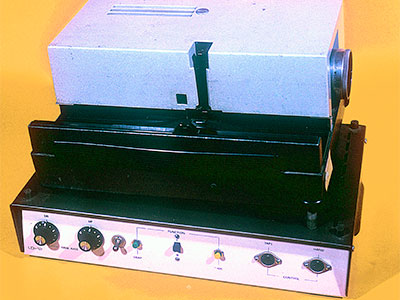
One of the early pro units was the Staysatom (shown left).You set the rate
of dissolve by turning the dials (left on the unit) but could not change them
during a sequence. This was the major disadvantage. It was pretty reliable and
mine was still working after many years in the loft when last tried.
Projectors
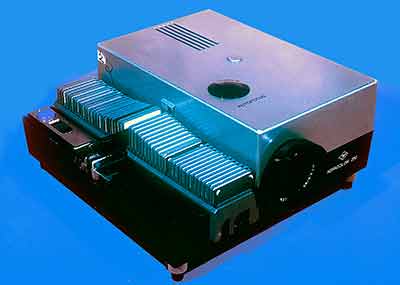
have changed over the years and there were basically three types - the Carousel
with its round tray holding 80 slides , the Lietz, Agfa type with the pushpull
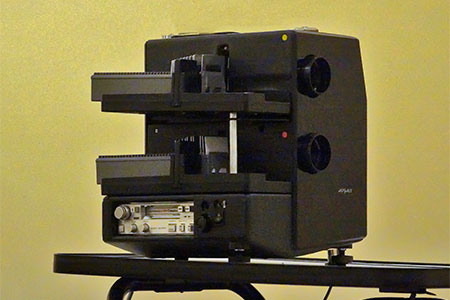
magazine ( pictured right) and the combined unit such as the Rollei or Royale
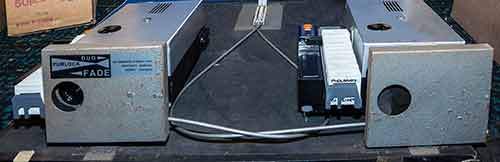
Access to the control unit is usually via a socket on the side of the projectorOne
of the commercial dissolve units was the Duofade (seen on the left is the second
one produced- still working) This was a manual device which consisted of two diaphragms
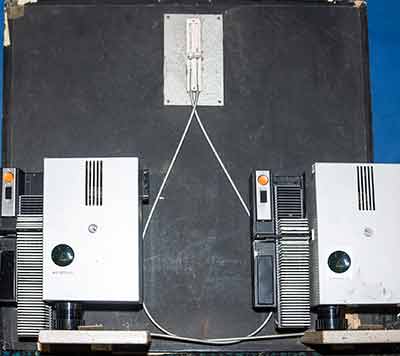
which were individually controlled via cables. The remote control from each of
the projectors are placed near the centre control so that the slide can be changed
quickly after the diaphragm for that projector had been closed. With skill it
was possible to achieve both beautifully smooth dissolves but also quick changes
with individual control of each projector. There was one snag - you really had
to know your sequence. You could also use the 1,000 cycle pulse as a guide but
concentration through the sequence was paramount especially if the sequence of
images was long.
Projectors
have changed over the years and there were basically three types - the Carousel
with its round tray holding 80 slides , the Lietz, Agfa type with the pushpull
magazine ( pictured right) and the combined unit such as the Rollei or Royale
Access to the control unit is usually via a socket on the side of the projector
Projectors
have changed over the years and there were basically three types - the Carousel
with its round tray holding 80 slides , the Lietz, Agfa type with the pushpull
magazine ( pictured right) and the combined unit such as the Rollei or Royale
Access to the control unit is usually via a socket on the side of the projector
Projectors have changed over the years and there were basically three types - the Carousel with its round tray holding 80 slides , the Lietz, Agfa type with the pushpull magazine ( pictured right) and the combined unit such as the Rollei or Royale Access to the control unit is usually via a socket on the side of the projector
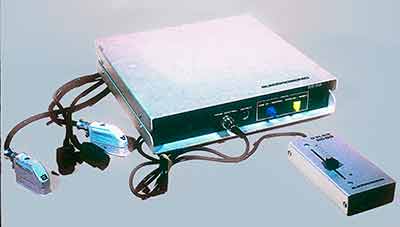
A semi professional unit for two projectors was the electrosoinc ES69. It was primarily used for industry and education as was its larger brother unit ES3609 which also had a tape recorder and loudspeaker. They were very reliable and I still have a working model.
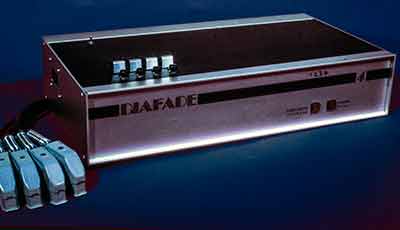
The brainchild of John Sandell (http://www.diafade.co.uk) The Diafade unit (above left) came in two versions, one for two projectors and one for four projectors.
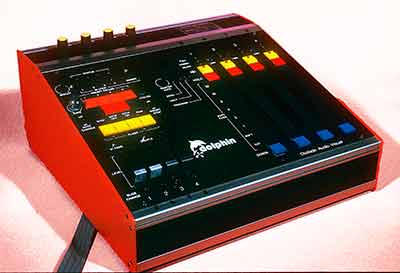
An extension to the 4 projector version was the Dolphin (top right) which was an automatic programming unit. I used them in many 8 projector shows for Nikon using 2 Diafades
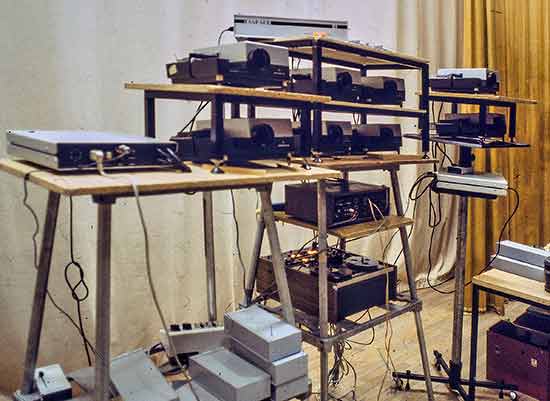
An earlier setup can be seen left. A four track tape deck was used for the sound and while the Diafade controlled the centre 4, a pair of ES69's controlled the outer 4.
A rear projection system was used which does require a reasonable working distance between the screen and projection system so most shows took place in theaters and halls that had a fair sized stage. It used to take quite a lot of time to set everything up and register the slides
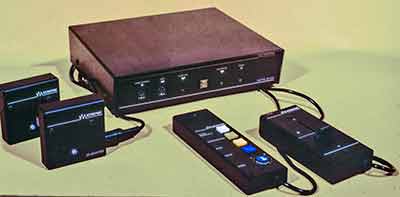
The imatronic SX2500 was an amatour dissolve controller in the early 80's
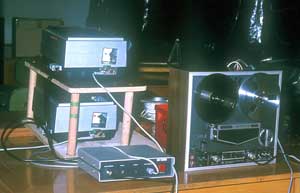
A few years ago a typical two projector amateur setup might look like the one
shown on the left.
Later reel to reel tape recorders were taken
over by cassette machines.
The Royale was a two projector combination with cassestte player and was very popular
Just heard about the passing of Sir George Pollock who was one of the early pioneers of audio visual and an excellent photographer. He was a past President of the RPS and I was fortunate enough to have known him and his wife Lady Doreen for many years. There is an excellent obituary HERE